TL;DR
September can be deceptive in Northern Utah. Cooler mornings may make it seem like AC season is basically over, but warm afternoons can still put significant demand on a cooling system that has already worked through an entire summer. If your AC is running but not cooling, blowing warm air, cycling frequently, making unusual noises, or taking longer to cool your home, waiting until next spring can allow a relatively manageable problem to become a larger repair. Christensen Air Solutions provides professional AC repair services throughout Davis and Weber counties, including 24/7 emergency AC service.
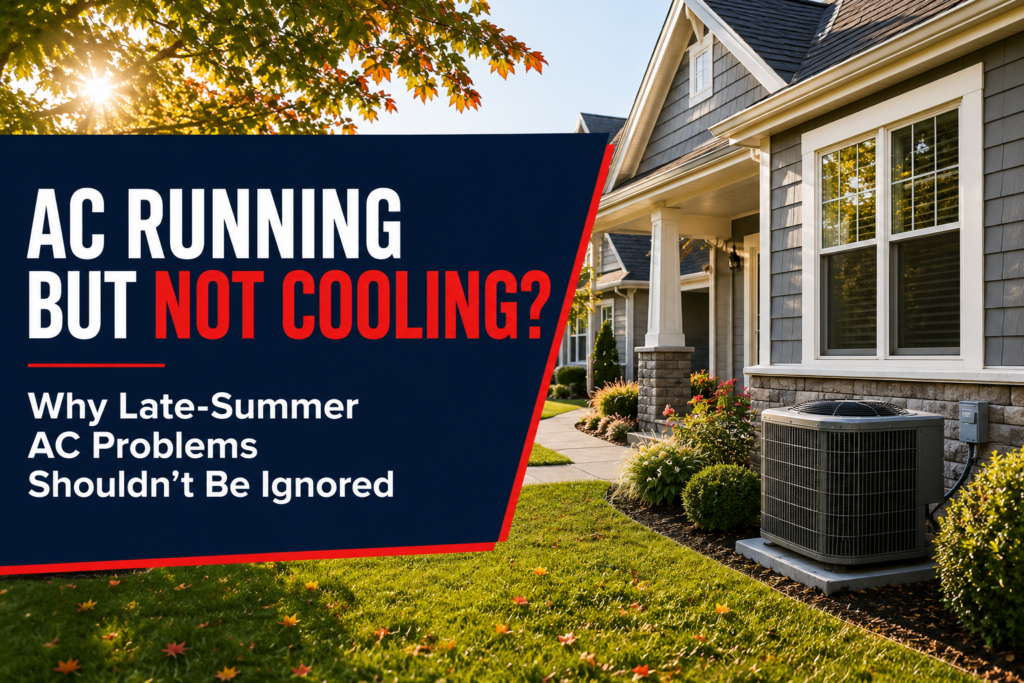
AC Running but Not Cooling? Why Late-Summer AC Problems Shouldn’t Be Ignored
September in Utah can make it tempting to stop thinking about your air conditioner.
The mornings are starting to cool down, evenings are more comfortable, and we’re getting the first signs that fall isn’t far away. After months of running the AC, plenty of homeowners are ready to turn it off and forget about it until next year.
But September isn’t necessarily the end of cooling season, especially across Northern Utah.
Warm afternoons can still push your air conditioner hard, and by this point in the year your system has already worked through June, July, and August. If something has started going wrong, those cooler mornings can actually make the problem easier to ignore.
Maybe the house still cools, but not as quickly as it did earlier in the summer. Maybe your AC seems to run longer in the afternoon. Perhaps one side of the house is noticeably warmer, or you’ve started hearing a noise from the outdoor unit that wasn’t there in June.
The easy answer is to say, “Summer is almost over. I’ll deal with it next year.”
Sometimes you can.
Other times, waiting several months turns a straightforward AC repair into a much bigger problem.
Why AC Problems Often Show Up at the End of Summer
Think about what your air conditioner has been through by September.
During the hottest stretches of a Utah summer, your system may run for hours every day. The compressor, condenser fan, blower motor, capacitors, contactors, refrigerant circuit, and other components all experience repeated operating cycles.
That doesn’t mean something should break every summer. A properly installed and maintained air conditioner should be designed to handle normal seasonal demand.
But sustained use can expose components that were already beginning to weaken.
That’s why a system can perform normally in May and June and start acting differently toward the end of August or September.
ENERGY STAR specifically identifies dirt and neglect as major contributors to heating and cooling system failure and inefficiency. It also notes that dirty coils can reduce an air conditioner’s ability to cool, causing longer run times and increasing energy costs.
ENERGY STAR HVAC Maintenance Checklist
So if your AC suddenly seems tired at the end of summer, don’t automatically assume you’re imagining it.
The system may actually be telling you something.
Your AC Is Running, but the House Isn’t Getting Cooler
This is probably the most obvious sign of a cooling problem.
You hear the system running. Air is coming from the vents. The thermostat says 76 degrees even though you’ve set it to 72.
An hour passes, and it’s still 76.
There are several reasons an AC can run without cooling properly, and not all of them mean you need a new air conditioner.
Restricted airflow can make it difficult for the system to move enough conditioned air through the house. Dirty evaporator or condenser coils can reduce heat transfer. Refrigerant problems can dramatically reduce cooling capacity. A failing component may also allow part of the system to operate while preventing it from cooling correctly.
This is where professional diagnosis becomes important.
Christensen Air’s AC repair service specifically addresses problems such as insufficient cooling, unusual condenser noises, frequent cycling, refrigerant issues, and unexplained increases in energy costs. Rather than assuming the equipment needs replacement, the goal should be identifying the actual source of the problem first.
Your AC Is Taking Much Longer to Cool the House
This one can be harder to notice because the system technically still works.
Maybe earlier this summer it took 30 or 40 minutes to bring the house down a few degrees. Now it feels like the system runs throughout the afternoon.
Longer cooling cycles aren’t automatically a problem. On particularly hot days, an appropriately sized air conditioner may need to operate for extended periods.
What matters is whether its behavior has changed.
If your AC handled similar temperatures earlier in the summer but now struggles to maintain the same indoor temperature, something may have changed within the system.
A dirty filter is one of the easiest things to check first.
ENERGY STAR recommends checking filters monthly during heavy-use periods. A dirty filter slows airflow and forces the system to work harder, which wastes energy and can contribute to equipment problems over time.
If the filter is clean and the problem continues, that’s when professional air conditioner repair becomes worthwhile.
Don’t Ignore an AC That’s Blowing Warm Air
There’s an important difference between weak cooling and air that is actually warm.
If your thermostat is calling for cooling but noticeably warm air is coming from the vents, something isn’t operating correctly.
Before calling for service, make sure the thermostat hasn’t accidentally been switched from “Cool” to “Fan.” You can also inspect the filter and check whether the outdoor condenser is operating.
Beyond those basic checks, you generally don’t want to start opening HVAC equipment or attempting electrical or refrigerant repairs yourself.
Low refrigerant, compressor problems, electrical failures, frozen evaporator coils, and condenser issues can all result in an air conditioner that runs without producing adequate cooling.
If you’re experiencing this problem in Layton, Ogden, Syracuse, Clearfield, Bountiful, or surrounding communities, Christensen Air provides AC repair throughout Davis and Weber counties and lists 24/7 emergency availability for urgent cooling failures.
Higher Electric Bills Can Be an AC Warning Sign
Not every AC problem announces itself with warm air.
Sometimes it shows up on your utility bill first.
Heating and cooling represent a substantial portion of household energy consumption, which means changes in HVAC efficiency can have a noticeable impact on energy costs.
If your electricity usage has increased substantially compared with similar weather periods and your household habits haven’t changed much, your cooling system is worth investigating.
An air conditioner that’s losing efficiency may compensate by running longer.
Dirty coils, airflow restrictions, incorrect refrigerant charge, deteriorating components, duct problems, and aging equipment can all contribute.
The important distinction is between a repairable efficiency problem and an aging system that no longer makes financial sense to keep repairing.
Those aren’t the same thing.
A good HVAC contractor should be willing to explain which situation you’re dealing with instead of automatically pushing replacement.
Strange AC Noises Are Worth Investigating
After listening to the same air conditioner all summer, you probably know what normal sounds like.
If something suddenly changes, pay attention.
Buzzing, rattling, grinding, repeated clicking, or other new sounds can indicate anything from a relatively minor loose component to a motor or electrical problem.
This doesn’t mean every unusual sound is an emergency.
It does mean you shouldn’t simply wait until next June to figure out what caused it.
One of the advantages of addressing an issue in September is that the system is still operating. A technician can observe the problem while the AC is actively being used rather than trying to diagnose an intermittent summer issue months later.
If the sound is accompanied by poor cooling, burning odors, electrical problems, or repeated shutdowns, shut the system down and have it evaluated.
Should You Repair an AC in September or Just Wait Until Spring?
This is really the central question.
If your air conditioner has a legitimate mechanical problem, there’s usually little benefit to deliberately leaving it unresolved for seven or eight months.
Problems don’t typically repair themselves while equipment sits unused.
And when that first genuinely hot stretch arrives next year, you’ll be starting cooling season with a known problem already inside the system.
There are exceptions.
If the issue is minor, the system is going to be replaced anyway, or a technician determines there’s no risk in postponing a particular repair, waiting may be reasonable.
But that decision should be based on knowing what’s wrong, not simply hoping the problem disappears.
If you’re unsure, Christensen Air’s broader HVAC services include repair and replacement options, allowing the system to be evaluated before deciding which direction makes sense.
When Repair Still Makes Sense
An AC problem at the end of summer does not automatically mean replacement.
If the equipment is relatively young, has been dependable, and needs an isolated repair, fixing it can make considerably more sense than purchasing a new system.
Imagine an eight-year-old air conditioner that has performed well every summer and suddenly develops one failed component.
That is a very different situation from an 18-year-old unit that has needed repairs three summers in a row, struggles to cool the upstairs, and has become increasingly expensive to operate.
The first system may have plenty of useful life remaining.
The second deserves a broader conversation about replacement.
This distinction is especially important because homeowners sometimes search “AC repair near me” expecting a repair and immediately worry they’re going to be told they need an entirely new system.
A diagnosis should come before that conclusion.
When Replacement Starts Making More Sense
Age alone shouldn’t determine whether an air conditioner gets replaced, but it absolutely belongs in the conversation.
ENERGY STAR recommends having equipment evaluated if it’s more than 10 years old or isn’t keeping the home comfortable. Frequent repairs combined with increasing energy bills are also signs that replacement may deserve consideration.
ENERGY STAR guidance on when HVAC replacement may make sense
That doesn’t mean an 11-year-old AC automatically belongs in the trash.
It means the economics begin changing.
If you’re considering putting a significant amount of money into an older air conditioner, compare the repair against the expected remaining life of the system, its efficiency, recent repair history, and the cost of replacement.
A $300 repair on a reliable older system can still be perfectly reasonable.
A major repair on equipment that’s already unreliable is a different decision.
Sometimes the AC Isn’t Actually the Entire Problem
Here’s another reason diagnosis matters.
A house that won’t cool evenly doesn’t always have a bad air conditioner.
Duct leakage, poor airflow, inadequate insulation, air leaks, and poorly conditioned additions can all create comfort problems even when the AC equipment itself is functioning.
ENERGY STAR specifically notes that rooms that remain too hot or too cold can be related to duct problems or inadequate insulation, not necessarily failed HVAC equipment.
This is particularly relevant in Northern Utah homes with finished basements, additions, bonus rooms, converted garages, or upper floors that were never particularly comfortable.
In some of those situations, a ductless mini-split system can provide targeted heating and cooling without forcing the central HVAC system to compensate for one difficult area. Christensen Air installs and repairs single-zone and whole-home mini-split systems throughout Northern Utah.
That’s a much different solution than replacing an otherwise functional central air conditioner.
September Is Actually a Useful Time to Evaluate Your HVAC System
There’s another advantage to dealing with AC problems now.
We’re entering the transition between cooling and heating seasons.
That makes September a good opportunity to understand the overall condition of your HVAC system rather than treating the AC and furnace as completely unrelated pieces of equipment.
For many homes, the furnace blower and duct system are also involved in distributing cooled air. Airflow problems you notice during cooling season can therefore matter when heating season begins.
And once fall temperatures arrive, your attention naturally shifts from the condenser outside to the furnace inside.
ENERGY STAR recommends annual HVAC maintenance, generally checking cooling equipment before cooling season and heating equipment before heating season.
So if you’re already having someone investigate a late-summer cooling problem, September creates a natural opportunity to start thinking about whether your heating system is ready too.
Local AC Repair Matters in Northern Utah
HVAC isn’t identical everywhere.
Equipment in Northern Utah deals with hot, dry summers, seasonal dust, substantial temperature swings, and a heating season that can begin surprisingly quickly once fall settles in.
Christensen Air Solutions is based in Layton and provides local HVAC service across Davis and Weber counties, including communities such as Layton, Ogden, Syracuse, Clearfield, and Bountiful.
That local context matters when diagnosing whether a system’s performance is actually unusual for the weather and home.
You can also explore Christensen Air’s broader Northern Utah service areas to see additional locations served.
Frequently Asked Questions
Why is my AC running but not cooling?
Restricted airflow, dirty coils, refrigerant problems, electrical failures, frozen coils, thermostat issues, or other mechanical problems can all cause an air conditioner to run without cooling properly. Check your thermostat and filter first. If the problem continues, professional diagnosis is recommended.
Is it normal for my AC to run for a long time on a hot day?
Long cooling cycles can be normal during particularly hot weather. What deserves attention is a significant change in performance, especially if the AC previously maintained your desired temperature under similar conditions but no longer can.
Should I repair my AC if summer is almost over?
Usually, it’s worth at least diagnosing the problem. Waiting until next cooling season means the existing issue may still be there when you need the system again. Whether the actual repair can wait depends on what’s wrong with the equipment.
How do I know whether I need AC repair or replacement?
Consider the system’s age, repair history, efficiency, cooling performance, and the cost of the current repair. A relatively young system with one isolated problem is often worth repairing. An older system requiring frequent expensive repairs may be a better candidate for replacement.
Does Christensen Air offer emergency AC repair?
Yes. Christensen Air Solutions lists 24/7 emergency availability for AC repairs and serves homeowners throughout Davis and Weber counties.
Don’t Carry This Summer’s AC Problem Into Next Summer
September feels like the finish line for air conditioning season, but that’s exactly why small cooling problems are so easy to put off.
If your AC has started blowing warm air, running longer, cooling unevenly, making unusual noises, or simply doesn’t feel like the same system you turned on earlier this summer, find out why before forgetting about it for the winter.
You may need a simple repair.
You may discover an airflow or maintenance issue.
Or, if the system is older and has been increasingly unreliable, it may be time to start planning for replacement instead of waiting for an emergency next summer.
The important thing is knowing.
Christensen Air Solutions provides professional AC repair in Northern Utah, with service throughout Davis and Weber counties and 24/7 availability for urgent cooling problems.
Schedule AC service with Christensen Air Solutions
Call 801-508-4816 or schedule online to have your cooling system evaluated.